
4-Month-Old Sleep/Feeding Guide: Wake Windows, Naps, and Sample Routines
Around 4 months old, sleep starts to look a bit different, for both babies and parents. Naps may become less predictable, bedtime may shift earlier, and many families notice their baby can stay awake a bit longer between sleeps.
If your baby’s schedule suddenly feels “off,” you’re not doing anything wrong. This is a period of BIG developmental changes, and sleep needs often adjust alongside it.
Below, you’ll find recommended wake windows, total sleep guidelines, and sample 4-nap and 3-nap schedules to help you build a rhythm that works for your baby.
Please remember: These are guides that aren’t meant to be followed strictly. In fact, it is very unlikely that your baby will follow this exact schedule– no matter how determined you are to make it work.
Every baby is different in their sleep needs; some 4 month olds take several 30 minute catnaps (which is normal), while others can nap for longer stretches (which is also normal), or a mix of both short and long naps, varying each day.
All of this is normal and completely dependent on YOUR baby. Any guide that you see online should be followed with the same disclaimer in mind.
The goal is to equip you with the recommended age-appropriate sleep guidelines (such as wake windows) so that you can create a unique schedule that works best for your baby.
Recommended 4 Month Sleep Guidelines
★ Wake windows: 1.5-2 hours
★ Number of naps: 3-5
★ Maximum daytime sleep: 3.5-4.5 hours
★ Night sleep: 10-12 hours
★ Total sleep in a 24-hour period: 12-15 hours
★ Daytime feedings: Every 2-3 hours
★ Overnight feeds: 1-2
More details about these recommendations below!
Sample 4-Month-Old Schedules:
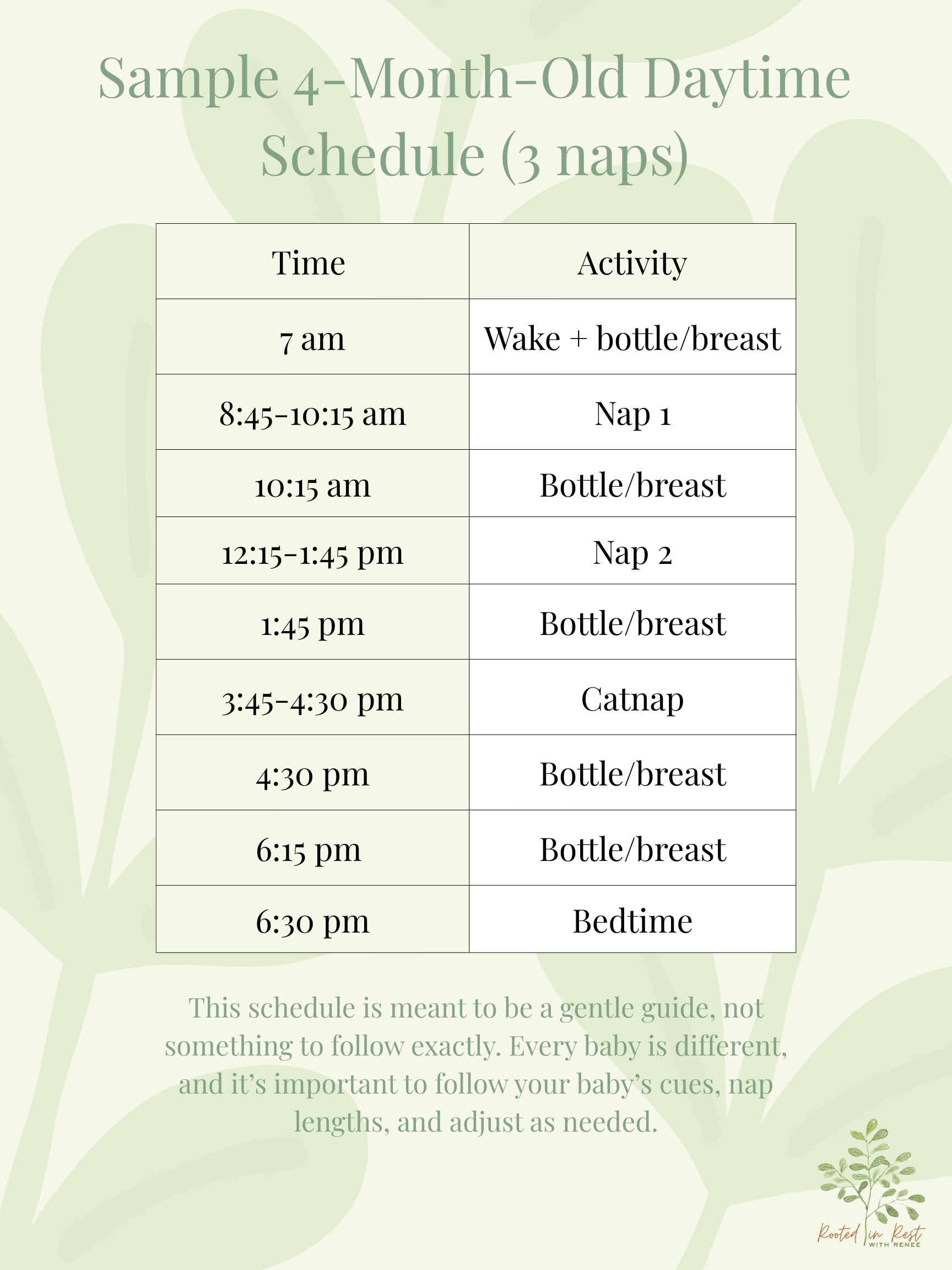
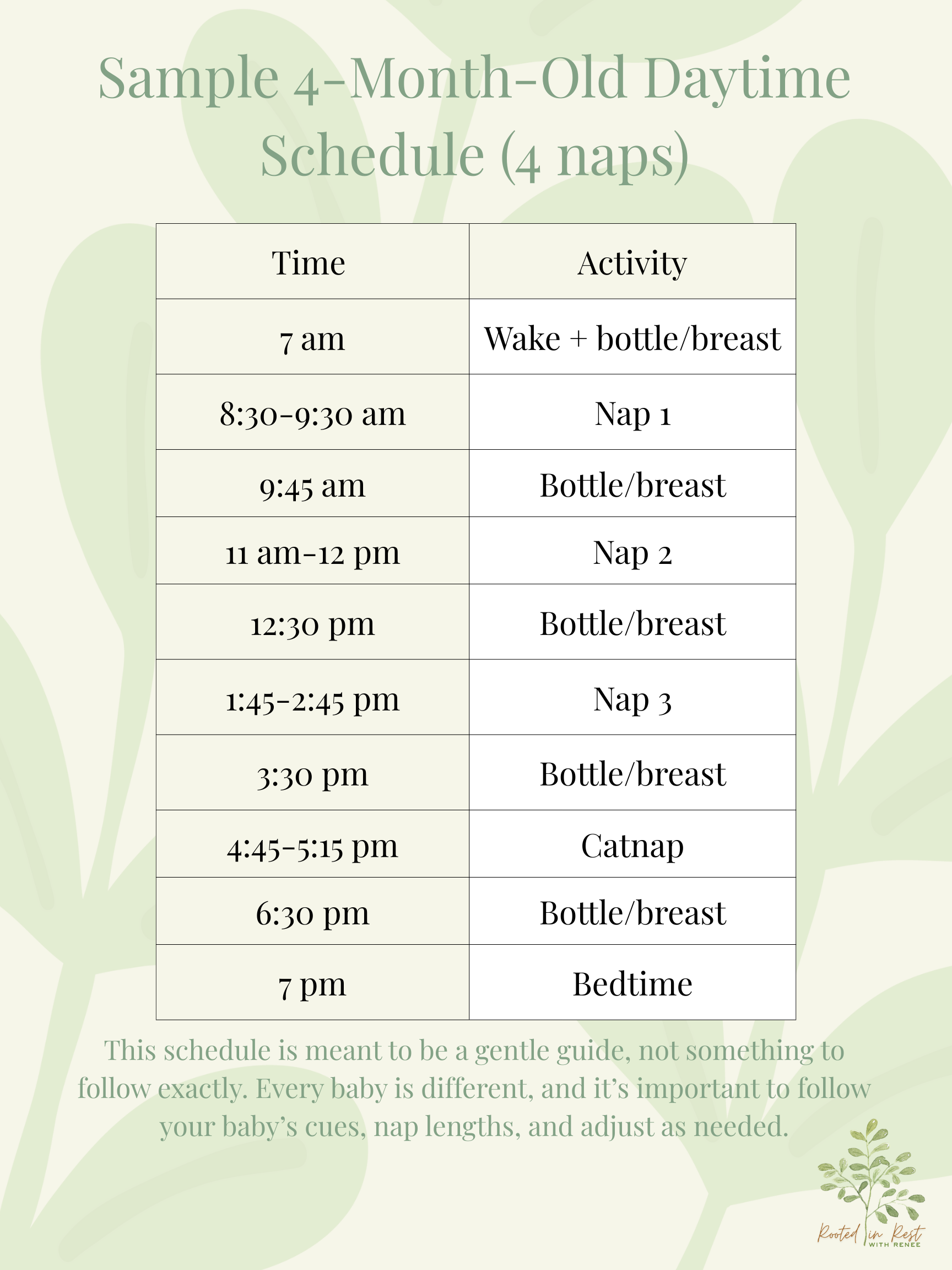
Recommended Wake Windows at 4 Months
Between 16-20 weeks (4 months), many babies do well with wake windows between 1.5-2 hours, though some babies may begin extending slightly beyond this. Keep in mind that as your baby gets older, these will continue to grow. A 16 week old baby may not be ready for a 2 hour wake window, even before bedtime. Likewise, a 20 week old baby with 1.5 hour wake windows, even in the morning, may be under-tired.
Wake windows also tend to be shorter in the morning and grow as sleep pressure builds throughout the day. You’ll likely notice longer stretches before bedtime compared to the first wake window of the day; this is normal and expected.
Wake windows are meant to be adjusted as the day goes on. If your baby takes a shorter nap than expected, adjust their wake window according to their wake-up time, even if they were supposed to be asleep for another 30 minutes.
→ While wake windows are a helpful guide, it is just as important to watch for your baby’s sleepy cues and overall mood to determine the wake window best suited for them.
If wake windows are too short, your baby may:
Take short naps + wake happy
Take a long time to fall asleep
Have early wakes
If they are too long, you may see:
Increased fussiness at nap + bedtime
More night wakings
Short, fussy naps
How Many Naps Should a 4-Month-Old Take?
At 4-months-old, some babies are taking 3 naps, while others may still be taking 4.
4 naps are more common earlier in the month, while 3 naps become more common as wake windows lengthen and naps consolidate.
As long as your baby is meeting their total sleep needs, the exact number of naps is less important.
For some babies, even 5 naps is appropriate if they are only taking short catnaps. For others, 3 long naps are enough.
Both can be completely normal.
Signs it may be time to drop a nap:
Baby takes longer than 20-30 minutes to fall asleep
Naps are consistently 30-45 minutes, even when tired
Sleep schedule becomes inconsistent
Naps shift earlier or later than usual
Baby seems alert and active when you would normally expect sleep cues
Baby can stay awake comfortably for longer stretches without becoming overtired
Yawning, rubbing eyes, or fussiness may appear later than usual
One nap consistently seems skipped (typically the last nap)
Bedtime is getting too late
Nap transitions happen gradually and don’t need to be rushed.
Total Sleep Needs at 4 Months
On average, 4-month-olds need 12-15 hours of sleep in a 24-hour period. This is typically broken down as:
Night sleep: 10-12 hours (with feeds)
Day sleep: 3.5-4.5 hours
To help protect nighttime sleep, I typically recommend a maximum of 4 hours of daytime sleep, especially if your baby is experiencing frequent night wakings or early morning wakes.
If needed, you can gently cap individual naps at 2 hours.
Remember: This isn’t necessary for every baby. Some babies naturally regulate their daytime sleep well on their own.
The Dreaded 4-Month Sleep Regression
Around 4 months, many babies go through what’s commonly called the “4-month sleep regression.” This isn’t a true regression, but rather a permanent developmental change in how your baby’s sleep cycles work.
During this time, you may notice:
More night wakings
Shorter naps
Increased fussiness
Greater difficulty falling asleep
This is completely normal. Maintaining age-appropriate wake windows and a consistent bedtime can help support your baby through this transition.
Are Short Naps Normal at 4 Months?
Many 4-month-olds still take short naps lasting 30-45 minutes. This is completely normal and related to sleep cycle development. Longer, more predictable naps often emerge over the next 1-2 months.
Need Help With Your Baby’s Sleep?
Sleep at 4 months can feel confusing, especially as your baby grows and their needs begin to change. Some days will go smoothly, while others may feel unpredictable—and that’s completely normal.
The goal isn’t to follow a perfect schedule, but to understand your baby’s sleep needs so you can create a rhythm that works for your family.
If you’re struggling with short naps, frequent night wakings, or figuring out the right schedule, you don’t have to navigate it alone. Gentle, responsive sleep support can make a big difference—not just for your baby, but for you, too.
If you’d like personalized support, you can learn more about my sleep consulting services here: